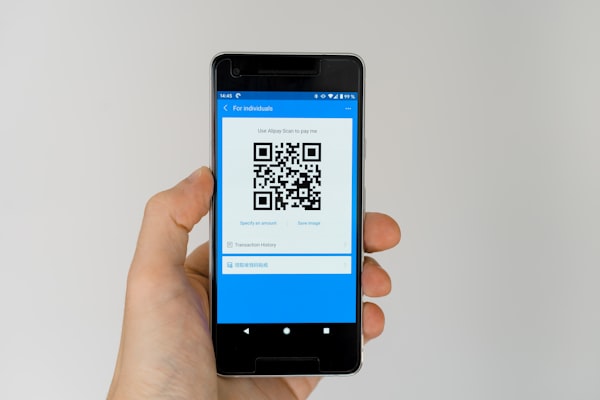
You scan them at restaurants, on product packaging, at payment terminals, and on posters at bus stops. They appear on business cards, billboards, concert tickets, and even tombstones. The humble QR code has become one of the most quietly transformative technologies of the past three decades. But the history of QR codes is far more interesting than most people realize - it involves a fateful game of Go, a forward-thinking Japanese engineer, and a decision not to patent an invention that would eventually connect billions of people to the digital world.
In this complete QR code timeline, we'll trace the QR code evolution from its 1994 origins on a Toyota factory floor to the AI-enhanced, design-forward, payment-enabled codes of 2026. We'll answer the question "who invented QR code?" in full detail and explore how a simple black-and-white square became an essential layer of modern infrastructure.
The Birth of the QR Code (1994)
The story begins in 1994 at Denso Wave, a Japanese subsidiary of the Toyota Group. An engineer named Masahiro Hara was tasked with solving a frustrating problem: the barcode system used on Toyota's assembly lines was too slow. Traditional barcodes, which store data in a single dimension (a series of vertical lines), required precise alignment with the scanner and could only hold about 20 alphanumeric characters. Each scan took three seconds or more - an eternity on a high-speed production line where thousands of auto parts moved past scanners every hour.
Hara needed a code that could be read from any angle, hold far more data, and decode in under a second. The answer, famously, came to him during a lunch break. Watching a colleague play the ancient board game Go, Hara noticed how the black and white stones on the grid created distinct, readable patterns. That visual insight - that a two-dimensional grid of contrasting modules could encode information efficiently - became the foundation of the QR code.
The name "QR" stands for Quick Response, reflecting the core design objective. Where a barcode is read by scanning a laser across a line of vertical bars, a QR code is read by a camera capturing the entire 2D matrix at once. This allows a QR code to be decoded in roughly one second - a threefold improvement over the barcodes it replaced.
The first QR codes could store up to 7,089 numeric characters or 2,953 alphanumeric characters, compared to a barcode's 20-character limit. They also introduced error correction, allowing the code to remain readable even when up to 30% of its surface area was damaged or obscured. This was critical for industrial use, where codes might be scratched, dirty, or placed on curved surfaces.
Perhaps the most important decision in the history of QR codes came shortly after the invention. Denso Wave chose not to enforce its patent rights on the QR code, effectively releasing the technology into the public domain. The company owned the patent but never exercised it, believing that widespread adoption would benefit the entire industry more than licensing fees ever could. This decision is why QR codes are free to use, generate, and scan without paying royalties to anyone - and why they became a global standard rather than a proprietary technology locked behind licensing walls.
Early Adoption in Japan (1994-2000)
In the early years, the Masahiro Hara QR code was used almost exclusively within Toyota's manufacturing and supply chain operations. Parts moving through assembly lines were tagged with QR codes that robots and handheld scanners could read instantly. The codes tracked everything from engine components to dashboard assemblies, feeding real-time inventory data into Toyota's production management systems.
Other Japanese manufacturers soon followed. By the late 1990s, QR codes were used across the automotive supply chain, in electronics manufacturing, and in pharmaceutical labeling. The error-correction feature made them especially popular for tracking parts through harsh environments - paint shops, welding stations, and warehouses where traditional barcodes would fail.
Outside Japan, adoption was minimal. The technology existed, but there was no consumer ecosystem to support it. Most people didn't carry a camera phone, and the phones that had cameras captured images at resolutions too low to reliably decode a QR code. The QR code evolution during this period was quiet and industrial - a practical tool for logistics and manufacturing, not yet a consumer technology.
Japan, however, was a different story. Japanese mobile carriers like NTT DoCoMo began integrating QR scanning into their phones as early as 2002. Users could scan codes printed in magazines, on posters, and on product packaging to instantly access mobile websites, download ringtones, or enter competitions. QR codes became a familiar part of everyday life in Japan nearly a decade before they reached the rest of the world.
The Smartphone Revolution (2007-2012)
The history of QR codes entered a new phase when Apple launched the iPhone in 2007. For the first time, a high-quality camera with autofocus was in millions of people's pockets. But the QR code evolution wasn't instantaneous - the iPhone's native Camera app could not scan QR codes until iOS 11 in 2017. Instead, third-party apps filled the gap.
QR Reader and similar apps appeared on the App Store in 2008 and 2009, letting users scan codes by launching the app and pointing their phone at the code. RedLaser (acquired by eBay in 2010) used barcode and QR scanning for product price comparisons. These early apps were clunky by modern standards - you had to open a separate app, wait for the camera to focus, and often the scan would fail if the code was too small or poorly lit.
Despite the friction, brands in the US and Europe began experimenting with QR codes in marketing campaigns around 2010. Movie trailers used QR codes on posters to link to exclusive video content. Music artists embedded codes in album art that led to bonus tracks. Real estate agents placed QR codes on "For Sale" signs linking to virtual tours. Starbucks launched a QR-based payment system in 2011 that would later become one of the most widely used mobile payment platforms in the United States.
But many early campaigns were poorly executed. QR codes were often placed where they couldn't be scanned easily - on moving subway cars, on billboards far from the sidewalk, or at sizes too small for phone cameras to read. The experience frequently required users to download a specific app, visit a mobile-unfriendly website, or endure slow load times on 3G networks. QR codes earned a reputation as a gimmick, and enthusiasm waned toward the middle of the decade.
Still, the seeds were planted. Smartphones were becoming ubiquitous, camera quality was improving, and mobile internet speeds were climbing. The QR code evolution was waiting for the right moment to explode.
The COVID-19 Turning Point (2020-2021)
If there is a single inflection point in the history of QR codes, it is the COVID-19 pandemic. When the world shut down in early 2020, contactless interaction went from a convenience to a public health necessity. QR codes were suddenly the safest way to access a menu, check into a building, verify a vaccination, or make a payment.
Restaurants around the world replaced their physical menus with QR code menus. A laminated card on each table directed diners to a digital menu on their phones. What started as a temporary pandemic workaround became permanent - four years later, QR menus remain standard in restaurants from Tokyo to New York.
Governments and health authorities adopted QR codes for contact tracing check-ins. In the UK, the NHS COVID-19 app used QR codes displayed at venues to log visitor attendance. Australia, Singapore, New Zealand, and Germany all deployed QR-based contact tracing systems. While the efficacy of these systems was debated, they normalized QR scanning for millions of people who had never used a QR code before.
Vaccination certificates - digital proofs of COVID-19 vaccination - were distributed as QR codes in most countries. The EU Digital COVID Certificate, which used a QR code containing encrypted health data, became one of the most widespread QR-based credential systems ever deployed, with over two billion certificates issued across the European Union.
The payments sector saw explosive growth. India's UPI (Unified Payments Interface) already used QR codes extensively before the pandemic, but COVID-19 accelerated adoption dramatically. By 2021, UPI QR payments in India were processing over three billion transactions per month. Singapore's PayNow, Thailand's PromptPay, and Brazil's Pix all relied on QR codes for instant bank-to-bank transfers. In China, QR payments via Alipay and WeChat Pay had been dominant since the mid-2010s, but the pandemic cemented QR codes as the payment method of choice across Asia and beyond.
Industry data from 2020 showed QR code usage increasing by over 400% in several Western markets. Both Apple and Google responded by building native QR scanning directly into their stock Camera apps - no third-party app required. The friction that had held QR codes back for years was gone.
Modern Era: Design, Tracking, and Innovation (2022-2026)
Once QR codes became a daily habit for billions of people, the technology evolved rapidly. The modern era of the QR code evolution is defined by three major trends: custom design, dynamic functionality, and ecosystem expansion.
Custom QR codes transformed the appearance of the technology. Instead of the utilitarian black-and-white squares of the 1990s and 2000s, modern QR codes incorporate brand colors, rounded modules, gradient backgrounds, and embedded logos. Designers learned how to manipulate QR code patterns while preserving scanability, and the results are often indistinguishable from artwork. Brands now treat QR codes as a design element rather than an eyesore, integrating them naturally into packaging, advertising, and digital content.
Dynamic QR codes became the standard for professional use. Unlike static QR codes - where the data is permanently encoded in the pattern - dynamic QR codes store a short redirect URL. This means the destination can be changed after the code is printed. A restaurant can reuse the same table tent QR code to point to a new menu every season. A marketing team can A/B test landing pages, update expired offers, or redirect traffic to a new campaign without reprinting materials. Dynamic codes also provide analytics: scan counts, geographic location data, device types, and timestamps - giving businesses visibility into how their QR codes are being used.
Augmented reality (AR) integrations added a new dimension to QR scanning. Scanning a QR code can now launch an immersive AR experience - a furniture store lets you see how a sofa looks in your living room, a museum exhibit includes hidden AR content behind a QR code, and a fashion brand offers virtual try-ons triggered by a code on a garment tag.
The payments ecosystem continued to expand. By 2025, QR-based payments accounted for over half of all retail transactions in several Asian economies and were growing rapidly in Europe and Latin America. The convenience of scanning a code to pay - no card, no cash, no contact - made QR payments the default for small merchants, street vendors, and peer-to-peer transfers.
Tools like UrsaQR made QR code generation accessible to everyone. Whether you need a free QR code generator for a personal project, a branded code with your logo for a business campaign, or a dynamic tracking solution with real-time analytics, modern platforms let you create beautiful, scannable codes in seconds. UrsaQR's card templates take it a step further, wrapping QR codes in professionally designed card layouts ready for printing or sharing - no design skills required.
What's Next for QR Codes?
The history of QR codes is still being written. Several emerging trends point to where the technology is heading next:
AI-generated QR art is one of the most exciting developments. Machine learning models can now generate QR codes that look like paintings, landscapes, or abstract art while still being scannable by standard readers. These "beautiful QR codes" push the boundaries of what the format can be - functional art that bridges the gap between utility and aesthetics.
Security improvements are addressing the "quishing" (QR phishing) threat. Verified QR code standards, tamper-evident code designs, and in-app preview features that clearly show the destination URL before opening it are making QR scanning safer. As QR codes become more central to payments and authentication, the industry is investing in trust mechanisms that let users verify a code's legitimacy at a glance.
Invisible and digital watermark QR codes are an emerging research area. Researchers are developing codes that are invisible to the human eye - embedded into images, packaging, or displays - and readable only through specialized camera software. These could be used for anti-counterfeiting, secure document verification, or seamless authentication without visual clutter.
NFC-QR hybrids are appearing in some markets. A single poster or product tag can include both an NFC chip and a QR code, letting users tap their phone (NFC) or scan (camera) depending on their device and preference. The combination creates a truly universal tap-or-scan experience.
iOS native scanner evolution continues. Apple's Control Center now includes a dedicated QR scanner, and the Camera app can read codes at extreme angles, in low light, and at smaller sizes than ever before. As scanning becomes more seamless, QR codes will appear in more contexts - embedded in video streams, displayed on digital signage that updates dynamically, and printed on ephemeral packaging that changes with each production run.
Conclusion
The history of QR codes is a remarkable story of timing, openness, and unexpected relevance. The question "who invented QR code?" leads to Masahiro Hara at Denso Wave in 1994 - an engineer who looked at a Go board and saw the future of data encoding. The answer to "when were QR codes invented?" is 1994, but the QR code timeline shows that the technology truly arrived in three waves: industrial adoption in Japan in the 1990s, smartphone experimentation in the early 2010s, and explosive global growth during and after the COVID-19 pandemic.
Today, QR codes are far more than the industrial tracking tools they were designed to be. They are payment infrastructure, menu systems, identity credentials, marketing channels, and creative canvases. The QR code evolution from a Toyota parts tracker to a 2026 design-forward, AI-enhanced, payment-enabled platform is a testament to what happens when a good idea is left open for the world to build on.
Whether you're scanning a code to pay for coffee, checking a restaurant menu, or creating your own QR codes with a free QR code generator like UrsaQR, you're participating in a technology revolution that started with a game of Go and a hunch that those black-and-white stones could be more than just a game.